Ask a manager how things are going right now and you will often get a version of the same answer. Fine. Busy. A lot on. Then, if you wait long enough, the real one: I am not doing any of it as well as I want to.
It is tempting to file that under attitude, or resilience, or the mood of the year. The data suggests something more structural.
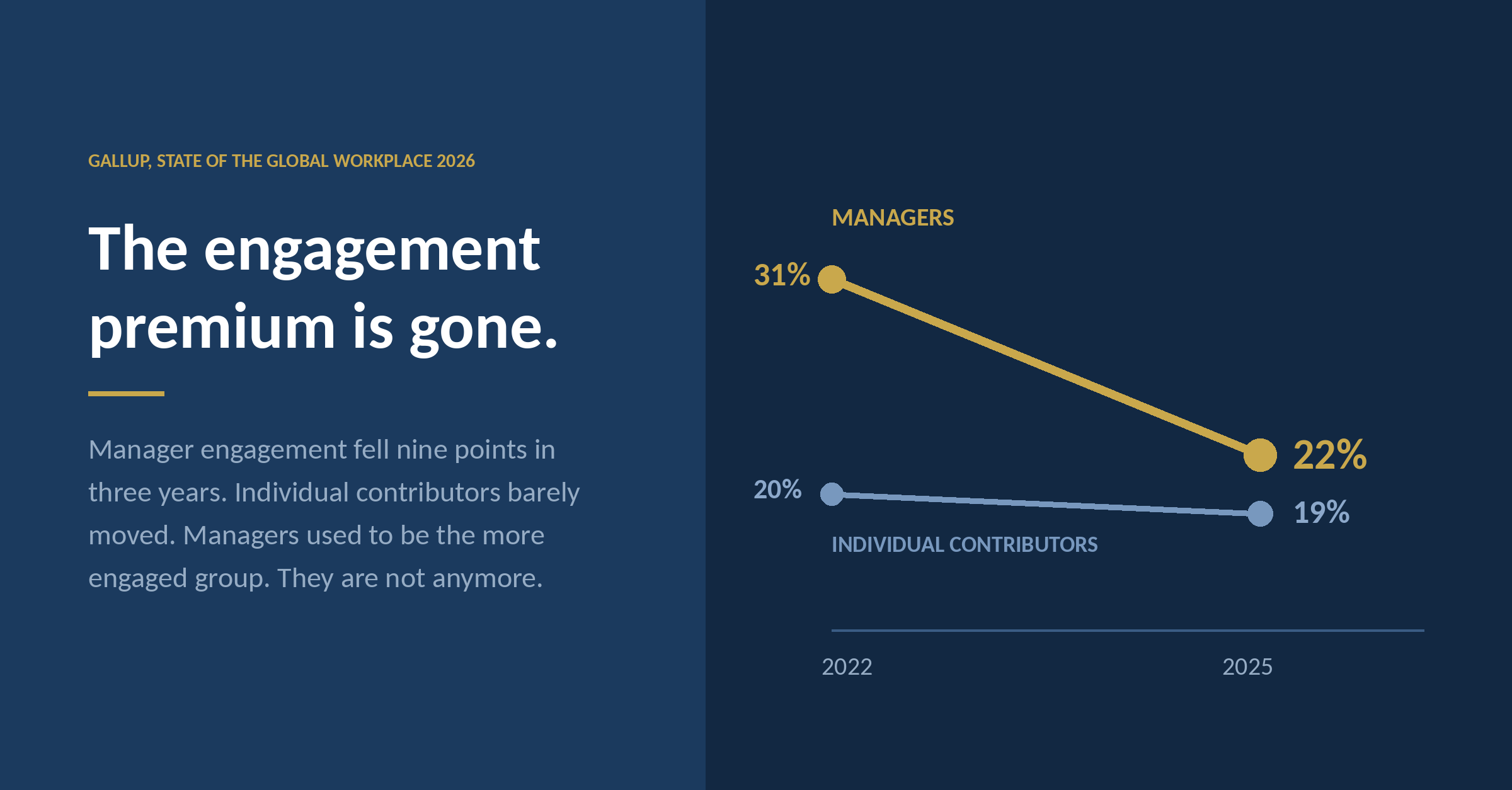
Gallup's 2026 State of the Global Workplace found that manager engagement has fallen from 31 percent in 2022 to 22 percent in 2025. Over the same window, individual contributor engagement barely moved, from 20 percent to 19 percent. Managers used to carry what Gallup called an engagement premium. That premium is essentially gone.
The decline is not spread evenly across the workforce. It is concentrated almost entirely in the people we depend on to carry everything else.
The Mechanism Is Arithmetic, Not Attitude
Gallup points to organizational flattening as a likely driver, and its research on team size finds that manager engagement declines as spans of control widen. That is the whole story in one sentence. Layers came out. Peers left and were not replaced. The managers who remained absorbed the teams.
A manager who went from seven direct reports to fourteen did not get twice the day. So something had to give, and it is worth being precise about what actually gives, because it is not the obvious thing.
The reports still go out. The meetings still happen. The forms still get filed, because those have deadlines and someone notices when they are late.
What disappears is the unscheduled work. The ten minutes with the person who has gone quiet. The second conversation about the feedback that did not land the first time. Noticing that a good performer has stopped volunteering for things. Sitting with someone through the messy middle of a change instead of resending the announcement.
None of that is on a deadline. Nobody notices for six months. And all of it is the part of the job that only a human in that role can do.
Why the Usual Response Misses
The common organizational answer to an overloaded manager is to offer support that is aimed at the symptom. Wellbeing resources. A resilience session. A reminder to set boundaries. These are well intentioned and they are not nothing, but they locate the problem inside the manager.
The manager is not the problem. The manager is where the problem is showing up first.
There is a second answer becoming popular, which is to point the new tools at the workload and assume the gap closes. That works for a specific slice of it. AI is genuinely good at the synthesizing, summarizing and status reporting that eats a manager's week, and handing that over is a real gift of time. What it does not do is have the conversation with the person who is quietly deciding whether to stay.
Three Things That Actually Move the Number
Look at the span before you look at the person. If a manager has fourteen or sixteen reports across two locations, no development program will fix what that structure is doing. Somebody needs to answer the question of what this manager is now expected to stop doing. Leaving that unanswered is a decision too, just an unspoken one.
Automate the administration and protect the judgement. If AI is going to buy a manager back four hours a week, name where those hours go before they get absorbed. Hours that are not claimed are not saved.
Develop the moments, not the models. An overstretched manager does not need another framework to remember. They need to have already practised the specific conversation they are walking into, so it costs them less when it arrives. That is a different design brief from a two day course, and it fits a calendar that has nothing left in it.
The Part Worth Taking Seriously
Gallup has long held that managers account for roughly 70 percent of the variance in team engagement. If that is even close to right, then a nine point drop in manager engagement is not a manager story at all. It is the leading indicator for everything downstream, arriving a year or two early and quietly.
Managers set the weather for the people they lead. Right now a lot of them are standing out in it themselves, with a bigger team than they had two years ago and fewer peers to compare notes with.
If you lead managers: when did you last ask one of them what they have quietly stopped doing?
If your managers are carrying more than they were two years ago, this is the kind of work I do: withimpact.com/coaching