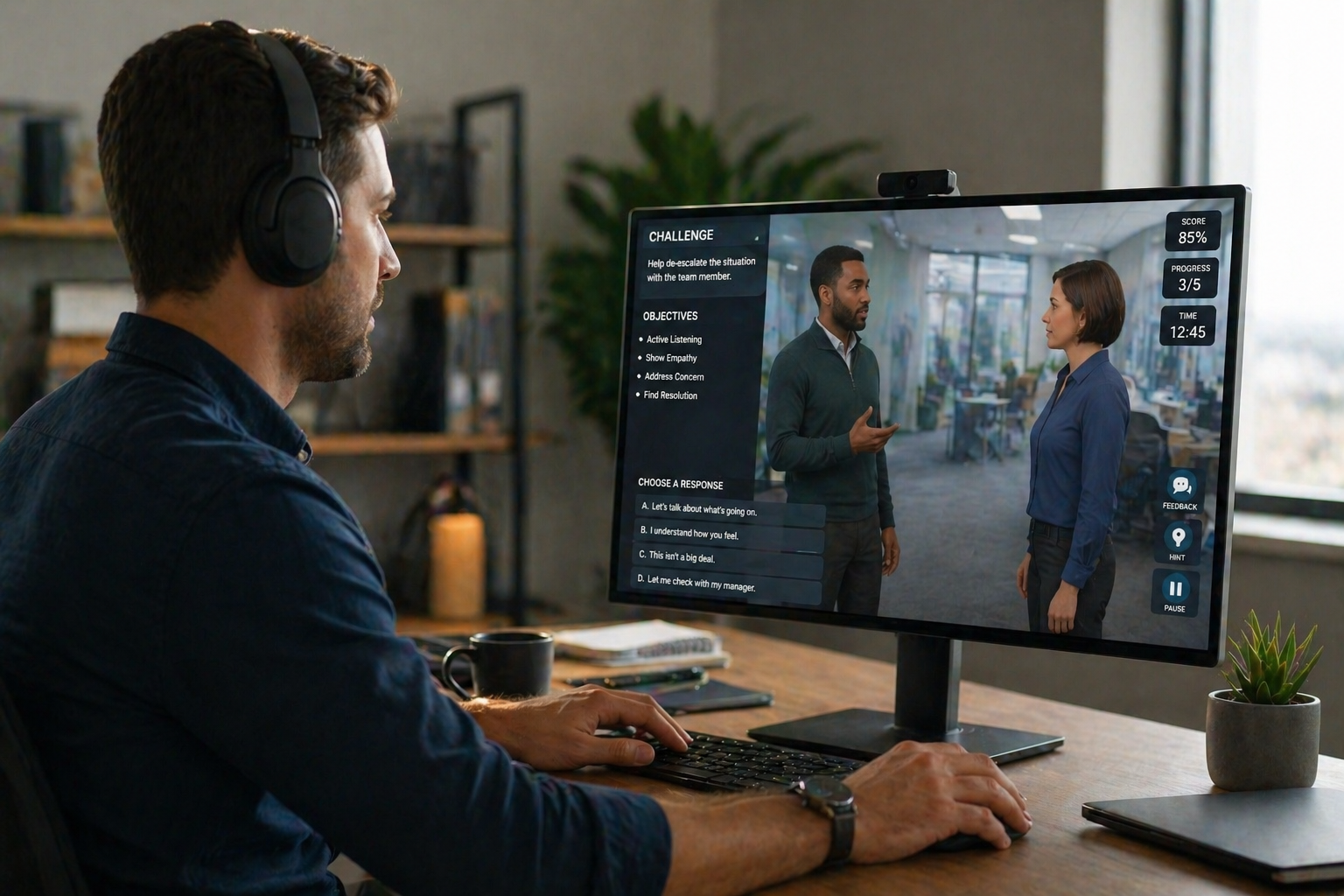
How Simulation-Based Learning Prepares Employees for the Modern Workplace
The changing workplace landscape relies heavily on adaptability and resilience. Employees today face more challenges than ever, and the pace of technological innovation requires teams to master new skills quickly to keep organizations running effectively. Simulation is a low-risk, high-impact way to prepare staff to confront novel and difficult workplace situations head-on.
Simulation-based learning is a form of experiential learning that offers real-world opportunities to develop and enhance knowledge in a controlled environment. Research shows it is a cost-effective and successful way to help employees develop critical skills through guided experiences that are safe, instructive, and interactive.
The Advantages of Simulation-Based Learning in the Workplace
Professional Development
Simulation-based learning ensures that employees receive real-time feedback on their performance. The ability to be immediately evaluated reinforces whether an approach is effective — accelerating learning and building confidence in a way that traditional training rarely achieves.
Deliberate and Repeated Practice
In many workplace settings, employees rarely encounter the same challenging situation more than once. Simulation changes that. By enabling repetitive practice with rigorous, immediate assessment, employees can build genuine competence in difficult or high-stakes scenarios before facing them in real life.
Strengthened Soft Skills
While simulation-based learning increases technical proficiency, it also has a strong positive impact on soft skills. These programs foster an environment where problem-solving, critical thinking, and communication naturally develop alongside the core content being practiced.
A Controlled Environment for Stress Management
High-stress environments lead to lower productivity, lost workdays, and high turnover. Simulation-based learning can place employees and leaders under temporary, manageable stress in a fully supportive setting — giving them the opportunity to practice and refine stress management techniques before a real situation demands them.
Risk Removed
One of the most significant advantages of simulation-based learning is the complete removal of real-world consequences. Trial-and-error in live environments has a direct impact on the bottom line. Inside a virtual environment, mistakes are consequence-free — giving employees the freedom to experiment, fail, learn, and grow without organizational risk.
Better Knowledge Retention
Training scenarios are designed to closely mimic real-life situations. When employees practice in these conditions, they develop a deeper understanding of the requirements of each task — helping them retain information faster and apply it more effectively when it matters.
How Can I Incorporate Simulations into the Workplace?
Simulations can be employed across many disciplines to bridge the gap between theory and practice. Organizations looking to get started will need to follow a clear process of planning, preparing, simulating, and improving to ensure measurable success with each program.
SIMpact Live™ can help you navigate the world of simulation-based learning — whether you're implementing it for the first time or looking to expand an existing program.