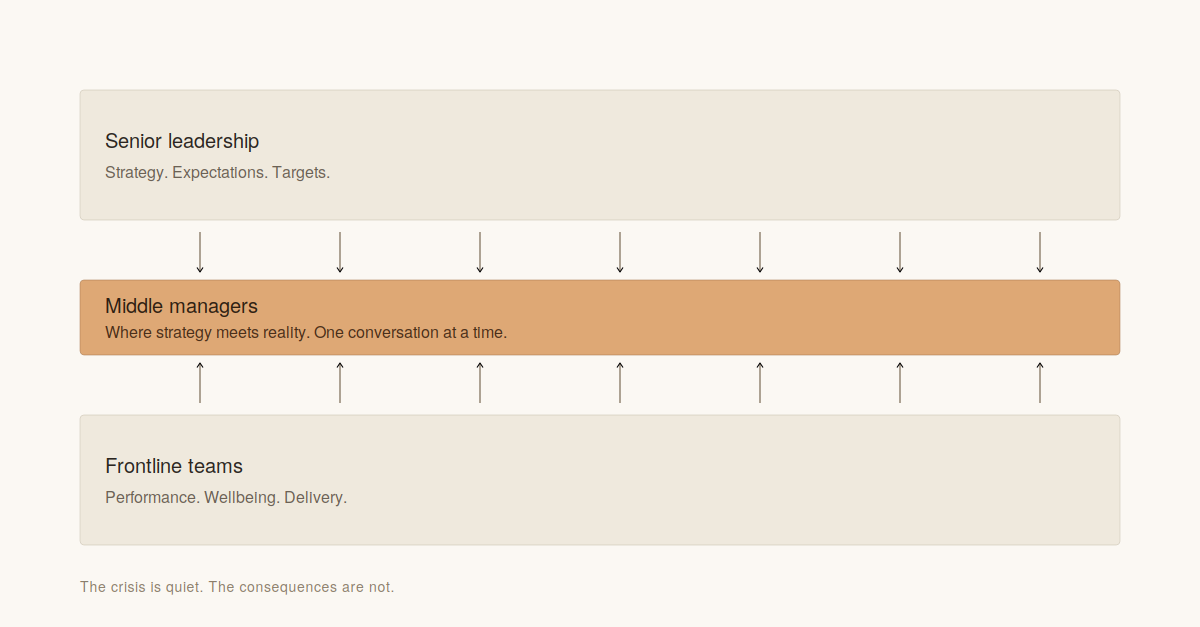
There is a leadership crisis unfolding in organizations across every industry, and most senior leaders aren't talking about it. Not because they don't know it exists, but because it is happening in a layer of the organization that rarely gets the attention it deserves.
Middle managers are burning out. And the consequences for organizational performance, culture, and retention are profound.
The Impossible Position
Middle managers occupy what organizational researchers have long recognized as one of the most structurally difficult positions in any organization. They are accountable upward for results they do not fully control. They are responsible downward for the wellbeing and performance of teams they often did not choose and cannot always resource adequately. And they are expected to translate organizational strategy into day-to-day action, a task that requires sophisticated communication, change management, and coaching skills that most of them were never formally taught.
The demands on middle managers have increased significantly in recent years. Remote and hybrid work has made the interpersonal dimensions of their role more complex and more time-consuming. Organizational restructuring has left many managing larger teams with fewer peers to consult. The pace of change, whether technological, structural, or cultural, has accelerated the volume of difficult conversations they are required to have, the ambiguity they are required to navigate, and the competing priorities they are required to balance.
And through all of this, middle managers remain the most under-invested leadership group in most organizations. Senior leaders receive executive coaching and high-level development programs. Frontline employees receive onboarding and role-specific training. Middle managers receive the least, yet are expected to deliver the most.
What Burnout Actually Looks Like in This Layer
Middle manager burnout rarely presents as dramatic breakdown. It is far more likely to look like gradual withdrawal: a slow reduction in discretionary effort, a retreat from the proactive leadership behaviours that once characterized someone's approach, a narrowing of focus from the broader team to the immediate task.
It looks like the manager who stops having development conversations with their team members because they no longer have the emotional bandwidth. The one who begins to avoid difficult feedback discussions because the energy required feels like too much. The one who starts processing organizational changes cynically rather than helping their team navigate them constructively.
None of these behaviours are dramatic enough to trigger concern at the executive level. But their cumulative effect on team engagement, performance, and culture is significant, and by the time the consequences become visible, the damage is already done.
The Skill Gap Nobody Is Addressing
Part of what makes middle manager burnout so damaging is that it is compounded by a skill gap that organizations consistently fail to address. Most middle managers were promoted into their roles because they were excellent individual contributors. The skills that made them successful in those roles, including technical expertise, task focus, and personal productivity, are largely irrelevant to the skills their new role demands.
Leading a team through change requires different capabilities than executing change yourself. Coaching an underperformer requires different skills than outperforming your peers. Facilitating a difficult team conversation requires different techniques than winning an argument. And navigating organizational politics while maintaining team trust requires a level of interpersonal sophistication that very few people develop without deliberate support.
Most middle managers figure these things out through trial and error over years of practice, at significant cost to themselves, their teams, and their organizations. The ones who receive structured development in these areas earlier in their leadership journey make the transition faster, perform better, and burn out less.
What Organizations Can Do
The solution to middle manager burnout is not wellness programs or flexible scheduling, though both have their place. It is investment, specifically investment in the leadership skills that middle managers need to perform their role effectively and sustainably.
This means giving them structured opportunities to practice the conversations they find most difficult before those conversations happen in real situations. It means providing coaching that addresses the specific leadership challenges of their role rather than generic leadership principles. It means creating peer communities where middle managers can process challenges, share strategies, and feel less isolated in what is, structurally, an isolating position.
The middle of an organization is where strategy meets reality. It is where culture is actually built or eroded, one conversation at a time. Organizations that treat this layer as a cost centre rather than a critical leadership investment will continue to see their best middle managers quietly disappear, whether into burnout or into a competitor's organization that treats them better.
The crisis is quiet. But the consequences are not.
If you are interested in leadership development solutions for your middle managers: withimpact.com/coaching-for-leader-and-teams